
- A. C. Huber, 120c, Princes St., Edinburgh and Aberdour, Impress stamp: Huber, 120 Princes St, Edinburgh
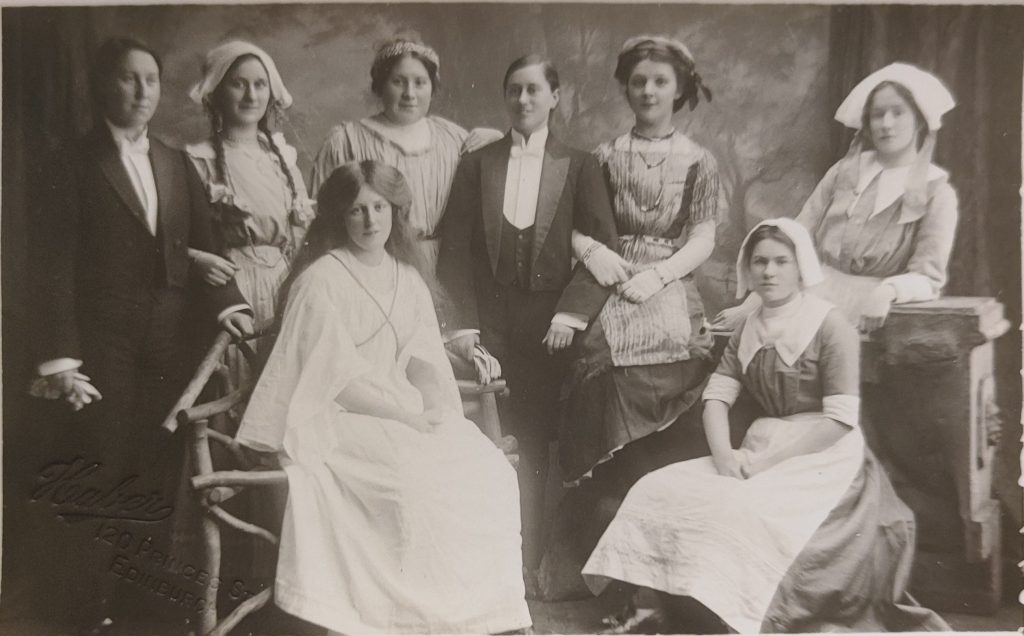
Augustus Charles Huber had a studio at 120c Princes Street from 1908 until 1917 although in 1912, 1914 and 1915 Huber was listed in MacDonald’s Scottish Directory and Gazetteer at 120B Princes Street. By 1912 Huber also had a branch at Aberdour, about twenty miles away on the Fife coast. The photographs taken there were developed in the Edinburgh studio.
Huber and Madame Huber worked for Parisian Photo Company in 1902 which had studios at 75 Princes Street from 1887 until 1914.
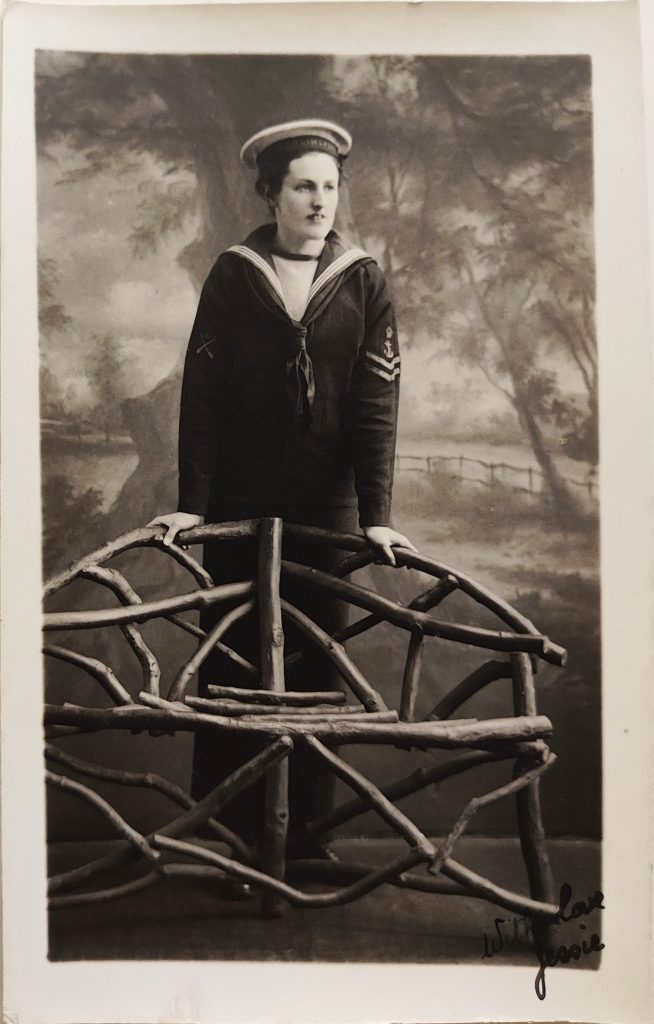
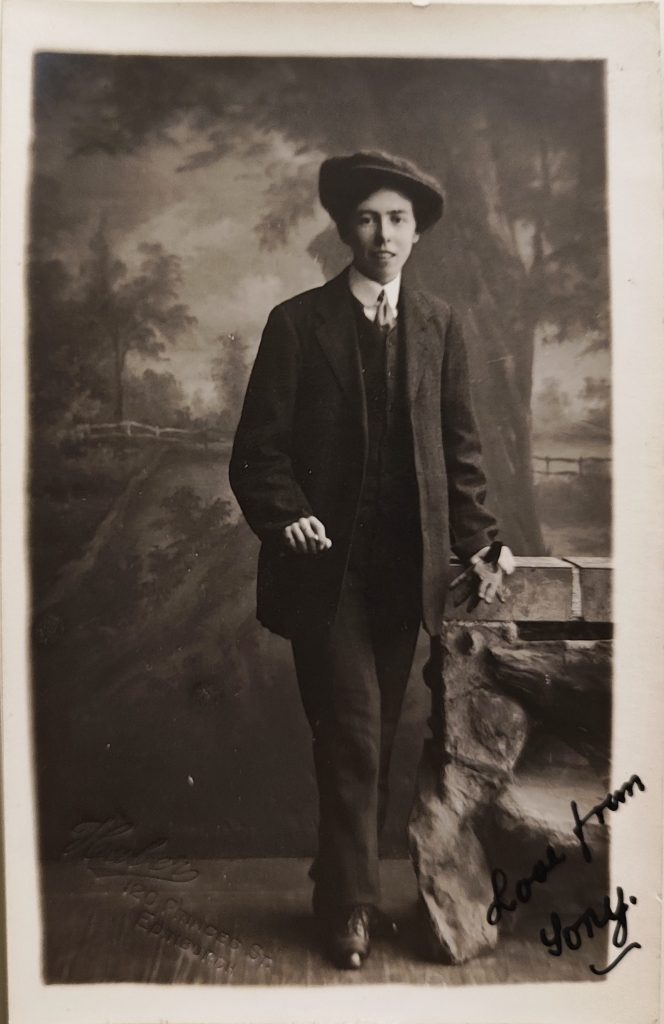
Huber is not a postcard publisher in the conventional sense; he was a photographer who followed a general practice of the time in supplying prints of his clients’ photographs on paper backed as postcards. The nature of this exercise could certainly mean that the examples shown here are the only surviving ones. The props in Huber’s studio included a motor car front behind which his subjects could pose as the occupants of a vehicle as well as the rustic bench seen in the photographs.
120c Princes Street was the top flat of a tenement let to Huber for the purposes of his photographic business in 1907. It was one of the original houses in the street, then at least 100 years old. Huber was allowed was to make alterations in the premises at his own expense to make them suitable for the business.
During the tenancy the owner of the tenement carried out alterations on the lower flats which required extensive building operations, and these caused structural and other damage in the top flat and interference with and detriment to Huber’s business.
Huber brought an action of damages against his landlord who admitted he was bound to restore the structural damage done to the tenant’s premises. In 1912 the Inner House of the Court of Session held he was also entitled to damages (1) for injury done to his furniture and materials; (2) for injury to his business during the work of restoration; and (3) for injury to his business during the landlord’s building operations, but only in so far as this was due to physical and tangible injury to the premises (as from vibration or dust), and not where it was immaterial or temporary (as from noise or occasional obstruction to the access). Miss Macrae, the pursuer’s book-keeper had said in evidence: ‘I was sometimes sent down by the pursuer to ask the workmen to stop for a little, in order to allow photographs to be taken. They usually stopped for a sufficiently long time.’ but this kind of disruption went uncompensated. Some idea of the situation can be gathered from the dissenting opinion of Lord Johnston who favoured a more generous approach:
I cannot discriminate as your Lordships do, between its causes, on the ground that dust and vibration are the result of physical disturbance of the subject let, and noise mere nervous affection of the occupants, whether the tenant or his customers, and interference with access a mere imaginary or sentimental consideration. Dust may have repelled customers, and spoiled plates. Vibration may have interfered with the obtaining of negatives. But I can understand a photographer’s customer being equally repelled by the noise created by masons and joiners, and still more by the condition of the only stair of access during the progress of the work. These are all connected with the execution of the work of alteration and directly connected with it, and independent of the use to which the adjoining premises are to be put after alteration.
From 1918 to 1956 Barrie’s Photographers were in 120c. Curiously, in 1925 The Capital restaurant was at the same address and in 1930 Carmino Demarco, father of Edinburgh arts legend Richard Demarco, had a restaurant at 120c Princes Street. Within a couple of years, Havana Dance Club was trading there, offering dancing to Harry A. Thorley and his band and a promise that “…that fed-up feeling will leave you the door…”
In 1934 the dance hall manager, the dance floor manager and the musical director of the Havana Dance Club were charged with allowing patrons of the establishment to bring in alcohol and then drinking it out of hours on the premises. The question for Sheriff Jameson was, whether it was a place of public resort within the meaning of the Licensing (Scotland) Act 1903 and whether the formation of the club was of a bona-fide club, or the formation of an institution or organisation that evaded the Act. The Sheriff was quoted as saying “I have always heard that this was a very respectable club.” perhaps an indication of the acquittal to come. The club features in studies of Edinburgh prostitution so Sheriff Jameson may have been misinformed.
By 1941, 120c Princes Street was still shared by Barrie’s photographers and the Havana Dance Club. How this cohabitation existed on a third floor tenement flat is far from clear. By the 1970s 120 Princes Street was the Mons Meg Tavern, the only pub on Princes Street. It is now a branch of The Willow Tea Rooms, Starbucks having moved next door.
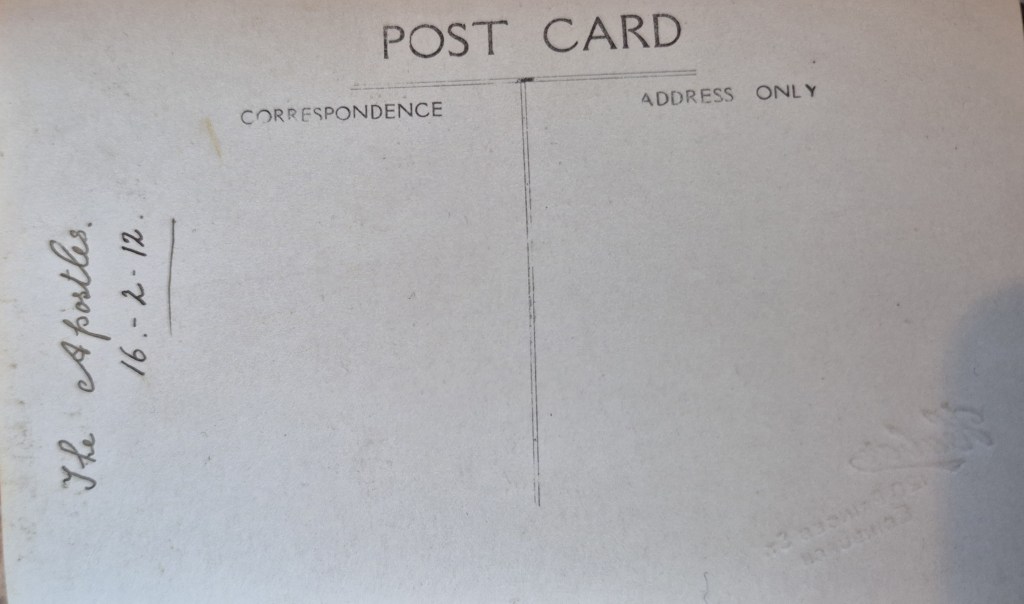
These Cards: The Apostles 16-2-12 All three of these cards have photographs of women dressed as men. The Apostles is written on the back of the group photograph. It is not clear whether the term applies to the group or a performance or play in which they were participating. Elgar’s oratorio of that name from 1903 is a piece for for soloists, chorus and orchestra and not likely candidate. The term apostle is used to designate an important missionary of Christianity to a region or a group. The 12 apostles, also referred to as the 12 disciples or simply “the Twelve,” were Christ’s twelve closest followers. Here there are only eight women.
Sources: edinphoto; Huber v Ross 1912 SLR 580 (20 March 1912); The Quiletti Family; MacDonald’s Scottish Directory and Gazetteer
Back to Lothian Postcard Publishers
 Lothian Postcard Club
You must be logged in to post a comment.