
We plan to publish a guide to Lothian postcard publishers of all eras. Many of those featured were not postcard publishers in the conventional sense; rather they were photographers who followed a general practice of the time in supplying prints of his clients’ photographs on paper backed as postcards. In other words, the only cards issued were those sold to the people in them. The nature of this exercise could certainly mean that the examples shown here are the only surviving ones.
James C. H. Balmain, Edinburgh
- Balmain Photographer
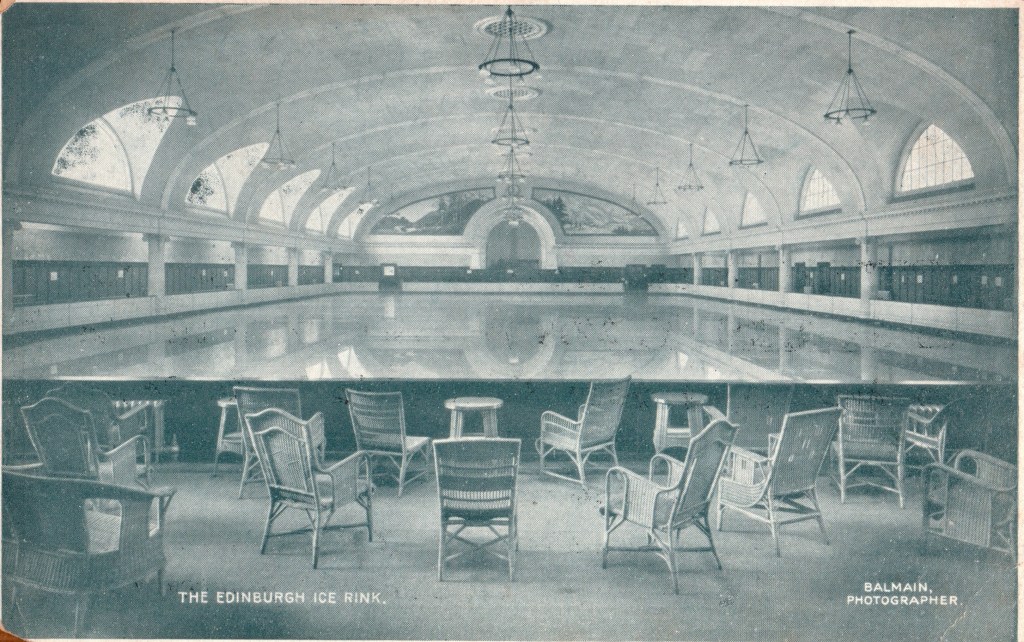
James CH Balmain (November 1853 to May 1937) was born in Philadelphia, Pennsylvania. In 1881 Balmain was working as a vitro enameller for Edinburgh photographer James Good Tunny and living with Tunny and his family at 11 Salisbury Place. It was Tunny’s address there that he gave as his own when he joined Edinburgh Photographic Society in 1881-82. In 1882 Tunny made an extensive trip to the United States, visiting studios in cities across the country as well as taking his own photographs.
After Tunny’s death in 1887, Balmain continued the business as JG Tunny and Co at 19 Salisbury Place and then under his own name there until 1897. Between 1888 and 1898 Balmain was at 13 Maitland Street and thereafter at Shandwick Place (the western extension of Princes Street), until 1909 at number 61.
In 1922 Balmain was at 69 Shandwick Place, above Robert Frost, artistic house furnisher, whose shop occupied 67 to 73. At one point he had studios at both 69 Shandwick Place and 19 Salisbury Place.
Balmain was Captain of the Merchant Golf Club and a member of several other golf clubs and Mayfield Bowling Club. He was a keen curler and a member of the Scottish Arts Club. He is buried in the Grange Cemetery in Beaufort Road, Edinburgh,
Sources: Capital Collections; Royal Academy; edinphoto
This card: Although not used until WWI, the printing on this card dates it to the 1902 to 1907 period.

John Bold, Edinburgh
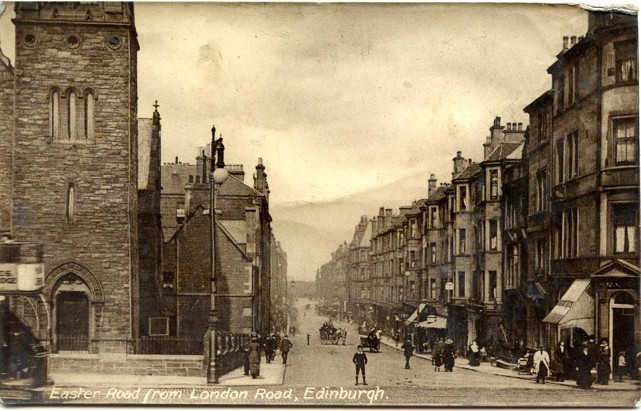
John Bold (22 May 1872 to 19 July 1937). Galashiels-born Bold published the Roxburgh series postcards for a short period before and during the First World War. These were real photographic cards of better than average quality and also fairly standard colour-litho cards, covering the whole of Edinburgh from Blackhall to Gilmerton. He largely commissioned postcards during the years between 1909 and 1919.
When he was eighteen years old and living at 84 Channel Street, Galashiels Bold was a woollen yarn store apprentice. By 1901 Bold had moved to 10 Marshall Street Edinburgh and was plying his trade as a draper’s traveller. By 1903 he had set up as a toy and smallware merchant based at 28 & 29 Drummond Street, Edinburgh, where he remained until 1908, moving the following year to 7 Roxburgh Place, Edinburgh where he transacted business until 1919.
From 1920 to 1925 he moved to 17 Drummond Place and was a wholesale warehouseman, availing himself of modern technology – telephone number 2268. The final move that has been traced was to 30 Morrison Street in 1927. John Bold died in Broxburn, described as a commercial traveller.
Bold was married four times to: Jeanie Henderson in 1899; Jessie Jamieson in 1906 (died 1910); Jeanie Rowan in 1911 (died 1912); Jessie Jane Jamieson in 1914 (died 1957), who registered her husband’s death.
The 1911 census shows John Bold, an employer, and his son John, living at 6 West Preston Street, Edinburgh, with his future father-in-law James B. Jamieson.
Augustus Huber, Princes Street, Edinburgh
A longer article on this photographer here
Alex Hutcheson, Colinton, Edinburgh
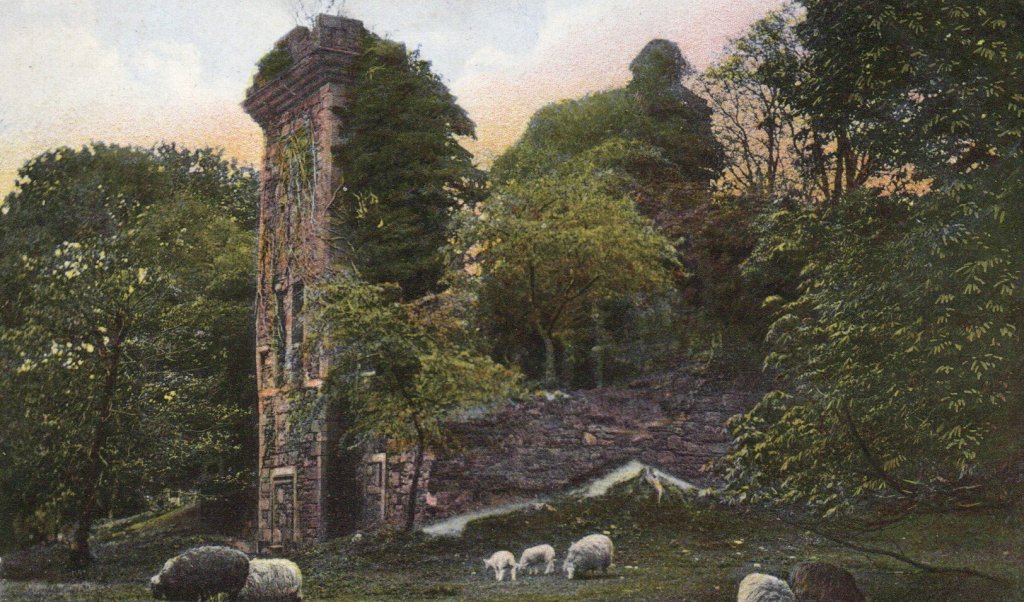
https://www.edinphoto.org.uk/PP_D/pp_hutchison.htm

Thomas Johnstone Kelly, Leith, Edinburgh
- T. Johnstone Kelly, Leith
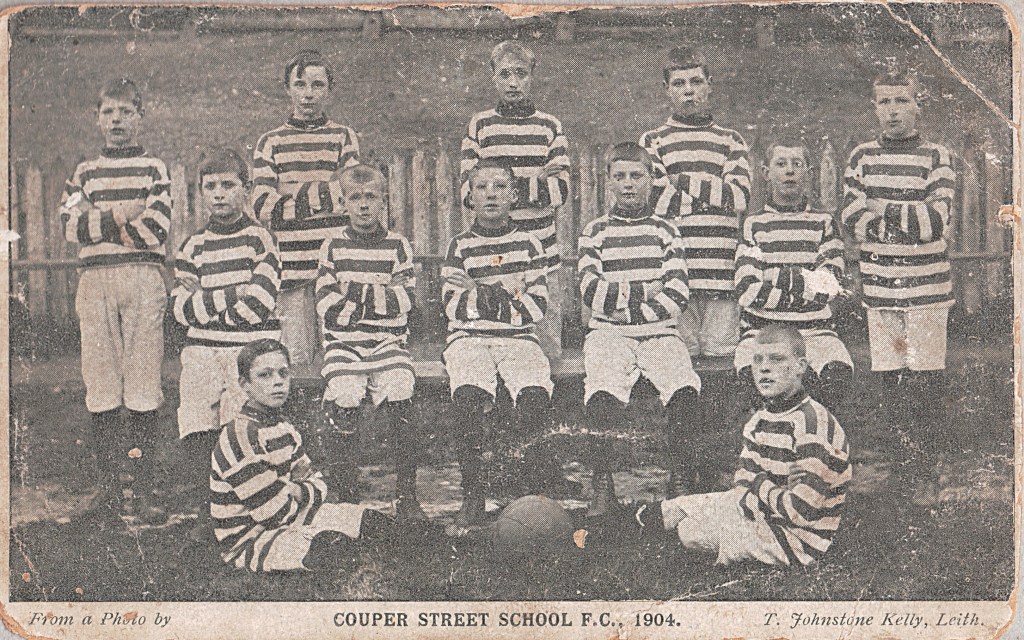
Photographer Thomas Johnstone Kelly advertised:“West End Studio. Artificial light and daylight studio” This studio was at 112 Ferry Road, on the west side of Leith.
In 1871 there were two Johnstone Kelly families in Midlothian.
This series of cards bearing his photographs also included one of official opening of the Leith Corporation Tramways on 3 November 1905.
Source: Edin Photo
This card: Couper Street School,on Couper Street, close to North Junction Street in Leith was built in 1890 by George Craig. George Craig JP EGS (1852 to 1927) was a Scottish architect and amateur geologist. He created a very high proportion of the 19th century public buildings in Leith. In 1876 Craig received a commission from the newly-created Leith School Board to design all of Leith’s schools required to meet the requirements of the new Education Act which required all children to be educated at public expense. His wife Annie Blackie lived to be 105 (1851 to 1957).
Three floors high with ornate iron railings along its roofline and a flagpole, Couper Street School had an offset entrance door with the school name carved above it. To the right stood the playground shelters. Latterly it served as the Ferranti Apprentices College.
The school and the chimney that served its furnace heating system were demolished in August 1984 though its gate piers and janitor’s house survive.
Sources: wikipedia George Craig (architect); edinphoto

Mason, Edinburgh

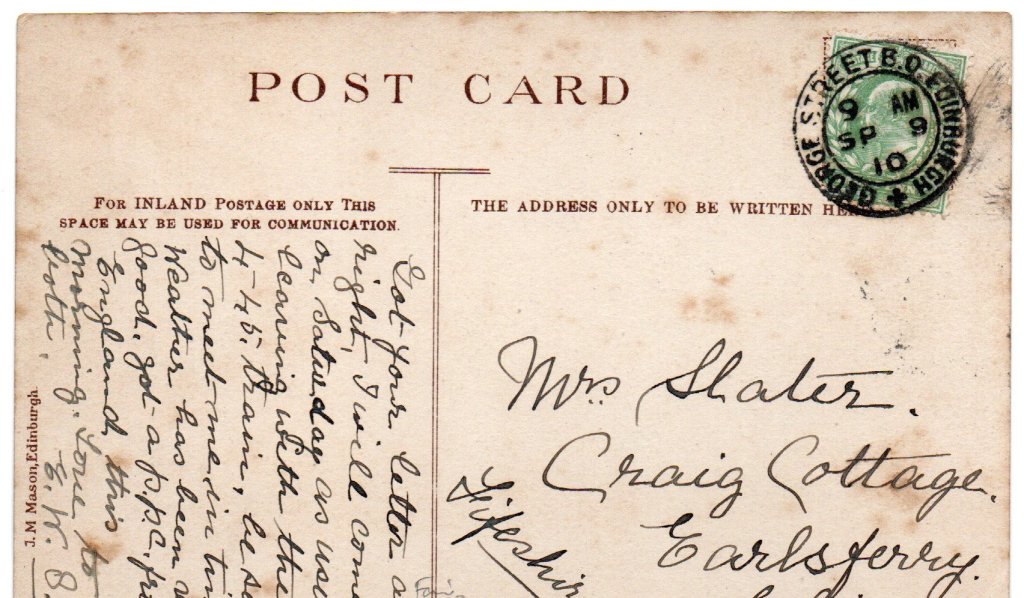
John A McCulloch, Edinburgh
- Caledonia Series – J. A. McCulloch & Co Ltd, Edinburgh
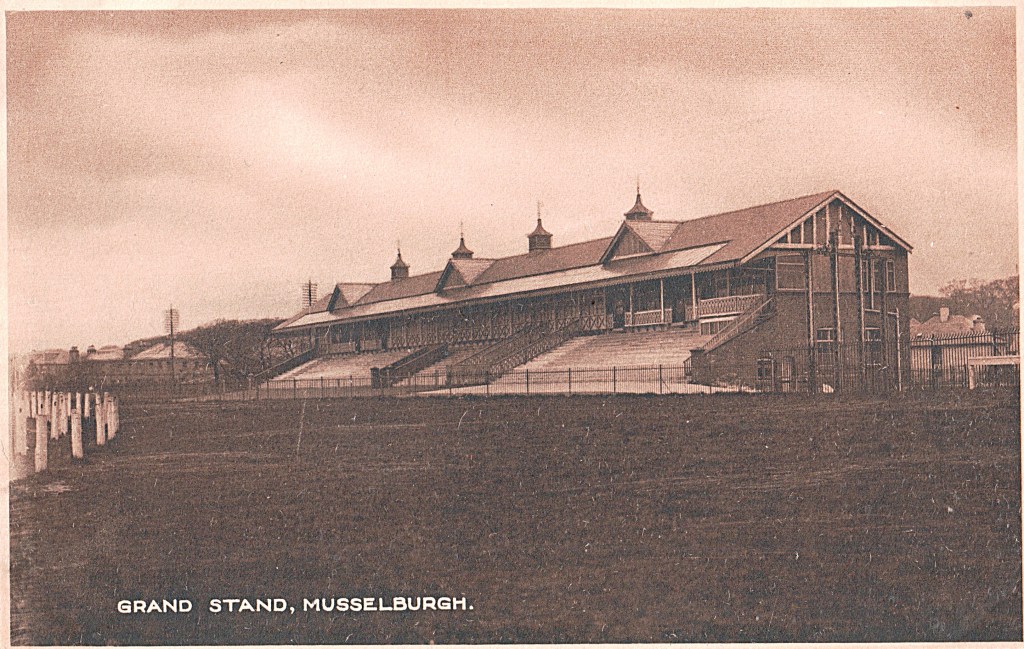
John A McCulloch, printer and stationer, Edinburgh. In 1905 McCulloch was describing himself as wholesale stationer, paper merchant, lithographic and letterpress printer at 70 Montgomery Street which is off London Road on the east side of the city. He was then living at 11 Leopold place a third of a mile away. The walk between home and work would take him past Hillside Crescent which was no doubt why he called his business Hillside Printing Works. By 1906 he had moved home to Belleview, Joppa, three or four miles to the east on the shore of the Firth of Forth.
In 1907 McCulloch relocated both work and home to Gorgie on the west side of the city, his home to Gorgie Farm. He took his Hillside Printing Works business and the name with him. The new works were in the industrial area behind the Delhaig tenements, an area approved for redevelopment to housing in 2022.
McCulloch published photocards of Scottish places well beyond Edinburgh and published under the name ‘Caledonia Series’. McCulloch used photographs by other people including Hartmann, Davidson Brothers, C Reid of Wishaw in North Lanarkshire and Valentines of Dundee, the major Scottish postcard publisher whom he credited with the initials JV after the number. McCulloch published photocards of the 1908 Scottish National Exhibition held in April/May 1908 at the Saughton Hall estate in Edinburgh.
By 1905, McCulloch was presenting images of Glasgow had expanded operations with a branch in Gordon Street, using the initials G & E after his own to indicate a presence in both cities. By 1921 he was also in Newcastle-upon-Tyne. In 1924 McCulloch and Hillside were still in Gorgie but the Glasgow printshop was at 29 St Vincent Place.
As well as postcards, McCulloch published at least one book (in 1907) – Historical Sketch of the 4th (Perthshire) Volunteer Battalion, The Black Watch. by Captain G. D. Pullar.
Sources: Edin Photo; MacDonald’s Scottish Directories
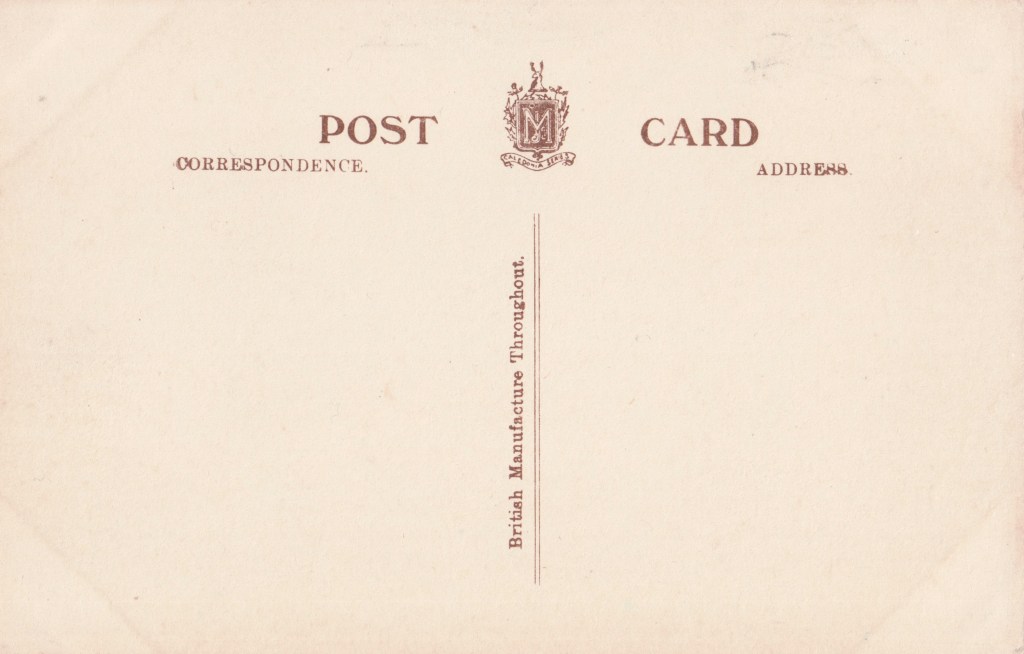
A.R. Montgomery, Juniper Green
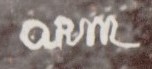
- a.r.m.

Alexander (“Sandy”) Robert Montgomery, (1874 to 1940) publisher of real photographic postcards, Juniper Green. This is a village on the outskirts of Edinburgh about 5.5 miles (8.9 km) south-west of the city centre.
Montgomery was born in Edinburgh at 13 James Street, Pilrig, the son of James Montgomery a coachman and Jessie Robertson. By 1901 he was an Ordnance Survey tracer and lived at 14 Dalmeny Street, off Leith Walk. The previous year he had married Eliza Wilcock in Chester. Perhaps he had been sent there Ordnance Survey to do some work by the. His first child, Alexander, was born in South Leith in 1901. Another son Thomas was born at Pentland Cottage, Juniper Green in 1910. The family lived in Juniper Green for many years:
1903 – 1921 Pentland Cottage, Baberton Avenue, Juniper Green.
1922 – 1950 Cairnbank, Baberton Avenue, Juniper Green.
Montgomery was a keen photographer and many of his photos were published in books about the South of Edinburgh, Colinton, Currie and Juniper Green and “A Water of Leith Walk”. He also took family portraits of the villagers and the ones taken of his own family show the fashions at that time. He was greatly assisted by his wife Eliza in the development of the plates and making copies of the prints.
Montgomery’s cards featured Colinton and the south side of the city and the Pentland Hills. Several were under the title Real Photo Series. Most of his postcards are identified by handwritten initials placed on the image side of the card.
Later in life Montgomery was described as an Ordnance Survey draughtsman. A draughtsman designs and creates drawings, while a tracer makes copies of those drawings. He is recorded at Cairnbank for at least ten years after his death; presumably his widow continued to live in the property.
Montgomery played football under the name of Sandy Hood with a team called St. Bernards and was invited to play as reserve goalkeeper for Heart of Midlothian the first time they won the Cup.
Sources: Richard Torrance; junipergreencc.org.uk The Montgomery Family 1901 – 1977
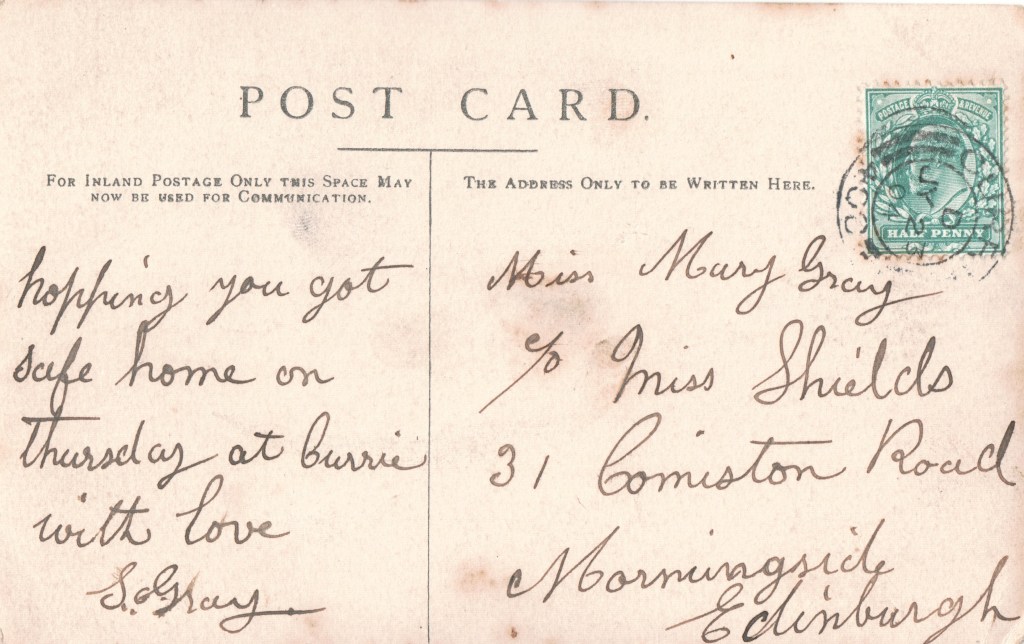
William Ritchie & Sons, Ltd., of Edinburgh
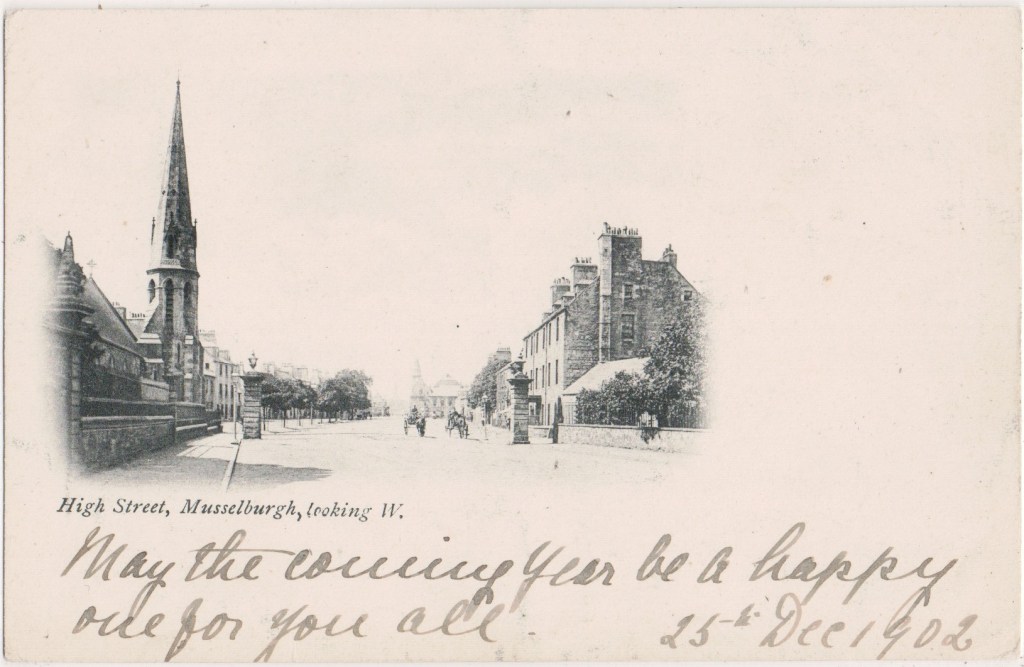
This Edinburgh company was the publisher of the Reliable Series of post cards, 1901 and 1928. William Ritchie (1824 to 1900) opened a bookshop “The Edinburgh Bible Warehouse” in St Andrew’s Square and later his business operated from 16 Elder Street. He was a member of the Photographic Society of Scotland from 1857 and of the Edinburgh Photographic Society from 1865. His sons carried on the business after his death and entered the card market by no later than July 1901. Their output extended to photocards of every part of Scotland and beyond; In 1906 the Caledonian Steam Packet Co. produced a series of beautiful cards featuring their most important steamers and routes. For this, they went to Ritchie and the cards appeared as coloured collotypes in their Reliable series.
In January 1907 Bookseller and Stationer of Canada journal reported:
“Among the new advertisers this month are William Ritchie & Sons, Ltd., of Edinburgh, whose Mr. H. Morrison has just arrived in Canada with a magnificent range of samples of Christmas cards, post cards and stationers’ sundries. The Christmas and picture post cards published by this house are already known to many retailers, but the Ritchie & Sons lines of stationery, papeterics, writing Mr. Morrison is justly enthusiastic over his samples, and at his request Bookseller and Stationer has undertaken to forward enquiries or other mail matter that may be addressed to him in care of any of our offices.”
Not to be confused with: In the last years of the nineteenth century William Ritchie & Sons, manufacturers were at 18 Church street in Ayr and JM and Mrs W Ritchie were at Windsor villa, 25 Miller Road It’s not clear if this was part of the Edinburgh firm.
Sources: Stationery & office products 1907; Borders Collections; undivided-back Reliable; Ayr Post Office General and Trades Directory for Ayr Newton and Wallacetown
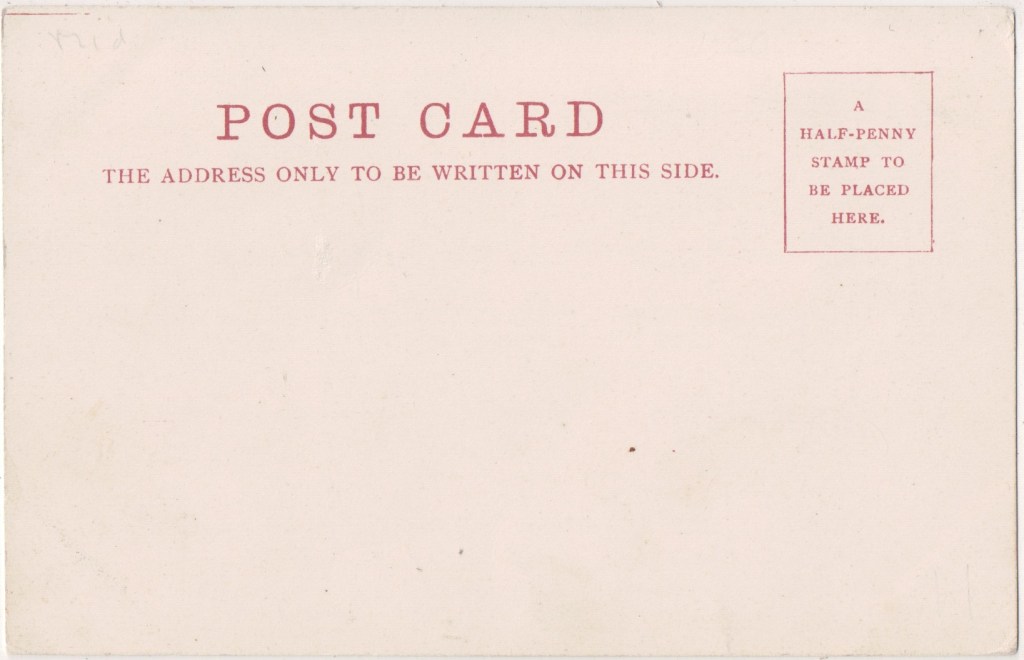
Alexander Roberts, Piershill Studio, Edinburgh
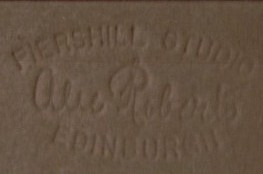
- Impress stamp: PIERSHILL STUDIO Alec Roberts EDINBURGH
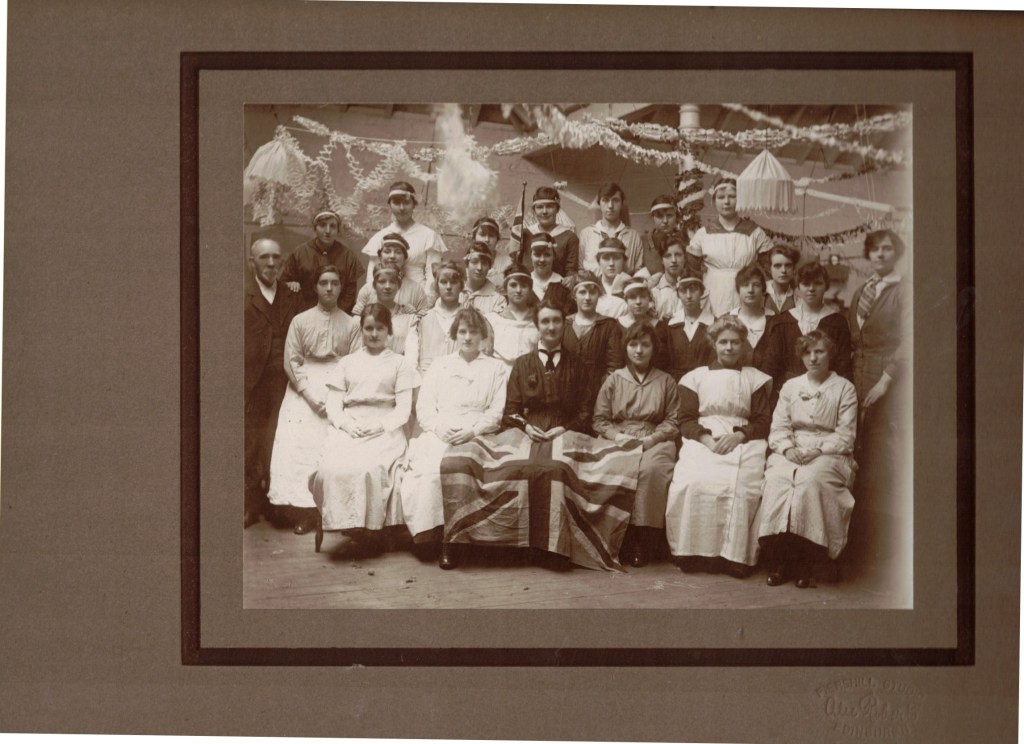
Alexander Roberts was a professional photographer from 1908 to 1941. Between 1912 and 31 he was at Piershill Studio. George Mckenzie’s Piershill Studio in 1880 to 81 was at Willowbrae House, Piershill, category C listed building dating from 1850 latterly 86 Willowbrae Road.
However, writing to EdinPhoto in the first decade of this century, Bryan Gourlay reported that his 90 year-old aunt remembered Alec Roberts’ studio in Piershill well, and had a number of photos taken there. It was in the line of shops near the Willowbrae Road / Smokey Brae (Restalrig Road South) junction – probably opposite Piershill barracks where Piershill Square was built. Piershill Barracks were built in 1794 and were home to various regiments including the 6th Inniskillin Dragoon Guards and the 17th Lancers. The barracks were demolished in 1938.
Another correspondent with Edin Photo wrote:
“The family photograph was taken in the gardens of our grandparents’ house, Abercorn. It was a lovely Georgian house and had vast basement rooms which were ideal for Uncle’s business.
It housed the hundreds of negatives in one room, a dark room and a developing room. Sheila (my mother) and I used to play at developing with packs of playing cards.
On the ground floor of the house, one room was allocated to the business and my father was in charge of a group of girls employed in the business.”
From this we might think that Roberts lived and worked in a lovely Georgian house called Abercorn, no doubt because it was in the nearby area of that name. Where this was and whether it was the location of Piershill Studio is not divulged.
From 1933 onwards, Roberts was based at 2 Northfield Road, an address sometimes described as Post Office, or sub-Post Office, Northfield Road.
In February 2007, Roberts’ niece Rose was reported as having written to his great niece Marilyn Evan :
“Uncle Alec was a well known and respected photographer in Edinburgh. I remember his mannerisms when he was photographing us, especially after the ‘take’.
Your mum and I used to get fed up with having to pose for photographs. She, like Tommy, their brother, was very photogenic and posed a lot for Uncle.
Your mum and I used to call at Uncle’s studio on our way home from school to play with the props; there was a black and white piano with the sound box removed, a staircase leading to nowhere, etc.”
Other phtographs show ballustrades that were perhaps less intriguing to youngsters.
Source: edinphoto
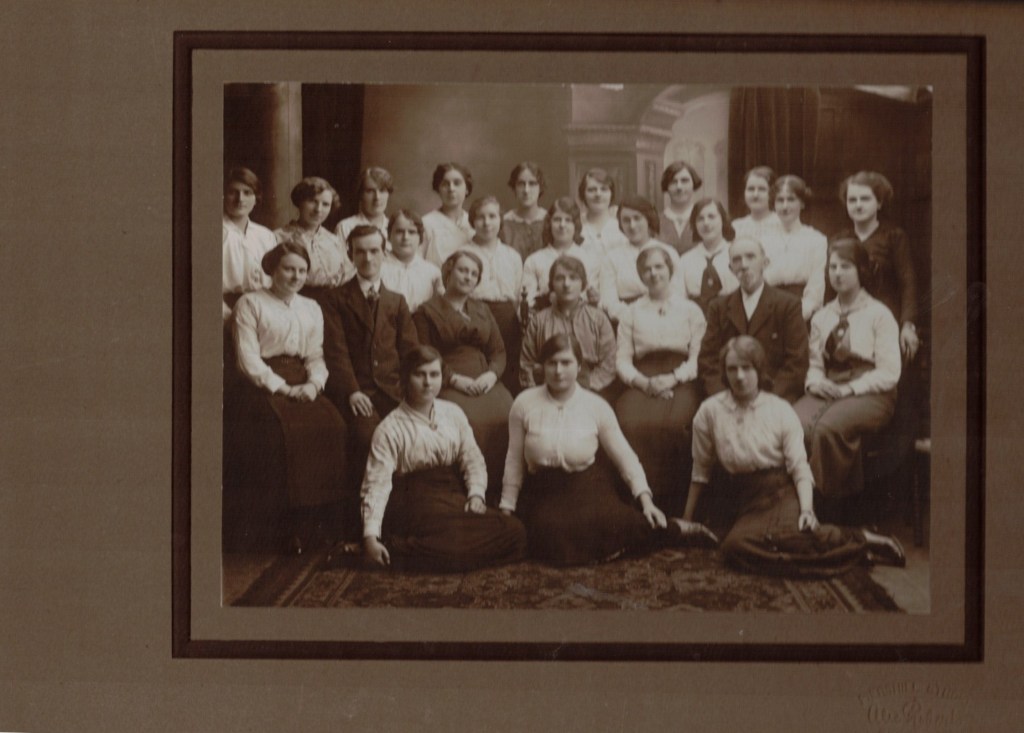
These Photographs: It’s clear that these two groups were significantly composed of the same people. Perhaps they were the photographer’s staff. In the upper photograph, the largely female group are perhaps celebrating the end of WWI.
J. Nicoll Small, Edinburgh and Kinnesswood
- J. Nicoll Small, photo, Edinburgh
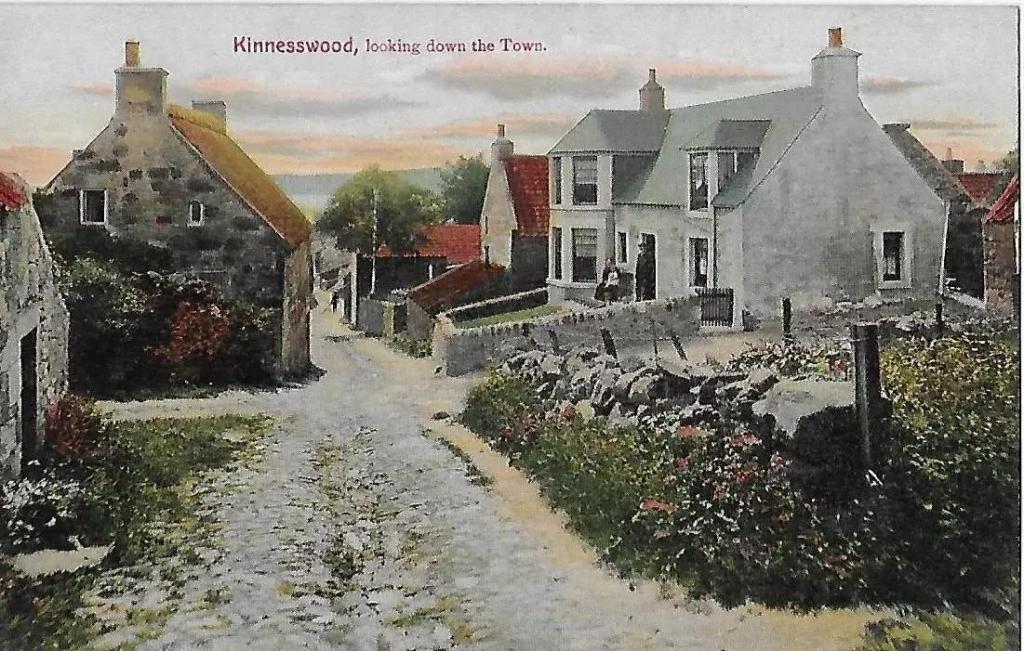
The son of a Balgedie minister, Small was described in the Edinburgh street directories as “Photographer, Lithographic Writer and Draughtsman”.
His studios were at 69 Jeffrey Street (1906 to 1910) and 30 Cockburn Street (1911 to 1919) and his postcards were limited to the Edinburgh area and Kinnesswood in Kinross-shire – photos he no doubt took while visiting family in the area and where he retired to .
John Ewart Simpkins’ 1914 book County Folk Lore Vol VII included photgraphs by Nicol of the ruins of Dunfermline Palace and of Carlin Maggie, a stone feature in Glenrothes in Fife said to be a witch on the receiving end of the devil’s wrath.
Some of Small’s glass plate negatives survive and are being used in a local history project.

 Lothian Postcard Club
You must be logged in to post a comment.