
There is a lot of information about postcards and postcard collecting out there on the web and elsewhere. Here are just a few links and sources which you might find useful – we hope to add more soon. Note that links will open in a new tab.
The postcard collecting community
| Postcard Traders Association | The Postcard Traders Association represents the UK’s foremost dealers, auctioneers, fair organisers, publishers and accessory distributors. Its website has much of interest, including an introduction to the hobby, and lists of dealers, fairs and other events. | Postcard Traders Association |
| Association of Scottish Philatelic Societies | The Association’s purpose is to co-ordinate and further the interests of philatelic and postcard societies in Scotland and to encourage the study of philately in all its branches, from traditional collecting to thematic, postal history and postcard collecting. Many postcard collectors are also stamp collectors, although it is by no means essential ! The ASPS holds its two-day Congress in April, with many postcard and stamp dealers attending from across the UK. | ASPS |
| Postcard fairs and organisers | The Postcard Traders Association has a comprehensive listing of fairs throughout the UK, and details of their organisers. For the main postcard events in Scotland, see the fair listing on our website. | Postcard fairs |
| Scottish Philatelic Trade Association | The Scottish Philatelic Trade Association holds stamp and postcard fairs in various parts of Scotland. | SPTA |
| Lothian Philatelic Group | The Group’s objectives are to encourage and promote all aspects of philately in the Lothians and surrounding area. Their members have varied philatelic interests including stamp design and production, cancellations, stamp collecting, postal history, and much more. Several of our members are also involved with LPG. | LPG |
| Kirkcaldy Stamp & Postcard Club | This busy local club began in the 1930s, and runs an active monthly programme for both postcard and stamp collectors. They also host at least one annual fair. | Kirkcaldy Stamp and Postcard Club |
| ‘Picture Postcard Magic’ magazine | There was a monthly magazine aimed at UK postcard collectors for over 40 years, called ‘Picture Postcard Monthly’. The hard copy publication under this title ceased in May 2023. But a new title, known as ‘Picture Postcard Magic’, was launched at the end of 2023 by Brian Lund, a long-standing British dealer who published the original magazine from 1980-2015. This is available on subscription via Mr Lund’s website, ‘Reflections of a Bygone Age’. The first few issues are available free to read online, from the links on the home page of the website. Back copies of the earlier magazines are generally available from the same site, and can sometimes also be found at postcard fairs. |
Postcard sellers
A non exhaustive list of retail businesses which have postcards in stock.
| Business | Description | Address | Website |
| Concorde Music | Family run CD and record store which also sells postcards, stamps, first day covers and football programmes | Scott Street, Perth PH1 5EJ | https://www.concordemusic.com/ |
| The Secret Door | Antiques and collectibles. | 12 Abbot Street, Dunfermline KY12 7NW | https://www.facebook.com/thesecretdoordunfermline/ |
| Keel Row Books | Secondhand bookshop with maps, postcards prints and ephemera | 93-97 Park View,Whitley Bay,NE26 3RJ | Keel Row Books | Contact us |
Postcard information and identification
There are many useful sites of postcard information worldwide, often run by small groups or individuals. Depending on your own interests, you will probably develop lists of your own favourites. But here are a few to get you started !
| Raphael Tuck | Raphael Tuck & Co. was one of the most prolific early British postcard publishers, publishing their first postcard in 1894. For several decades they produced many tens of thousands of different cards on a wide variety of topics, often in small sets, and their cards remain popular now amongst collectors. The continuing interest and vast number means that a large database does exist of their cards, with over 136,000 examples, although even this almost certainly incomplete. Even so, it is an extremely useful resource. | TuckDB Postcards |
| Undivided back postcards | One important type of early postcard is what is known as an “undivided back’, generally dating from about the 1890s to about 1907. The back side of these postcards was reserved solely for the address, and message had to be written on the front of the card, next to the image. One of our own members, Mungo Bovey, has produced an excellent website listing the publishers of these cards, with many cards illustrated and extensive details about publishers worldwide. It’s well worth a look if you like these kind of cards ! | Undivided Back Postcards |
| ‘Postcard History’ | This is an interesting and colourful American site dedicated to vintage and historic picture postcards and the many stories associated with them. It regularly posts new richly illustrated articles designed to both inform and entertain postcard collectors and history buffs. | Postcard History |
Reference books
There are some useful books as well, which are usually fairly easy to find second hand on sites like Abebooks, Ebay or Amazon. Most were published in the 1970s-1980s, at the start of the modern era of postcard collecting, but still provide much excellent advice and information – gathered in the old way, pre-internet ! We have listed some in the table below, and aim to add a few more in the coming months.
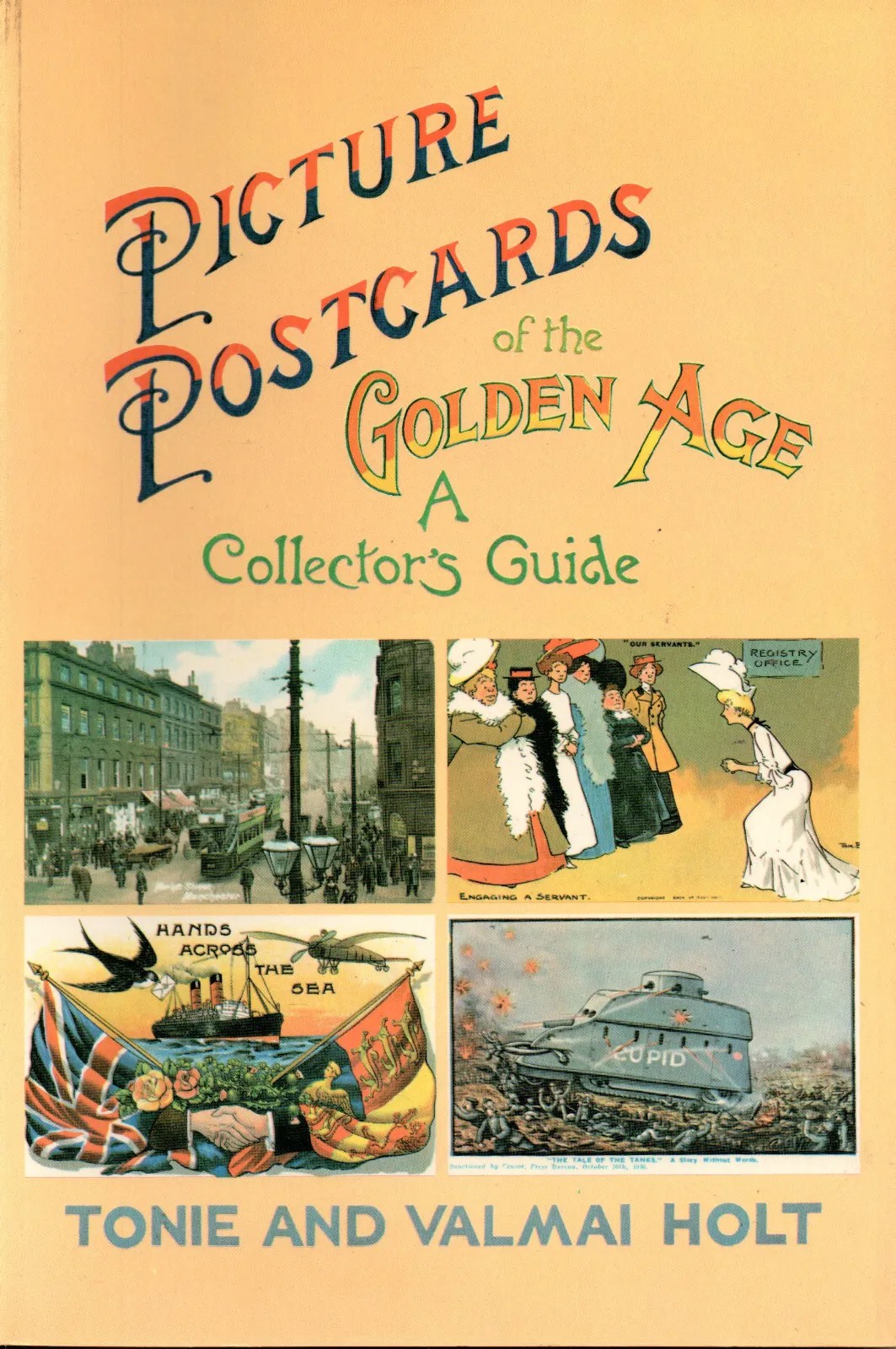 | Picture Postcards of the Golden Age – a collector’s guide (Postcard Publishing Company, 1978, no ISBN for this paperback edition). This was written by Tonie and Valmai Holt, a well-known team of authors on postcard topics. Although published in 1978, it remains a very useful volume. Chapters include the early history of the picture postcard ; mechanics of collecting ; topographical cards ; topic and commemorative cards ; how to date postcards ; how to value postcards ; postcard publishers ; and much more. Note there was an earlier hardback published in 1978, ISBN 9780261632455). |
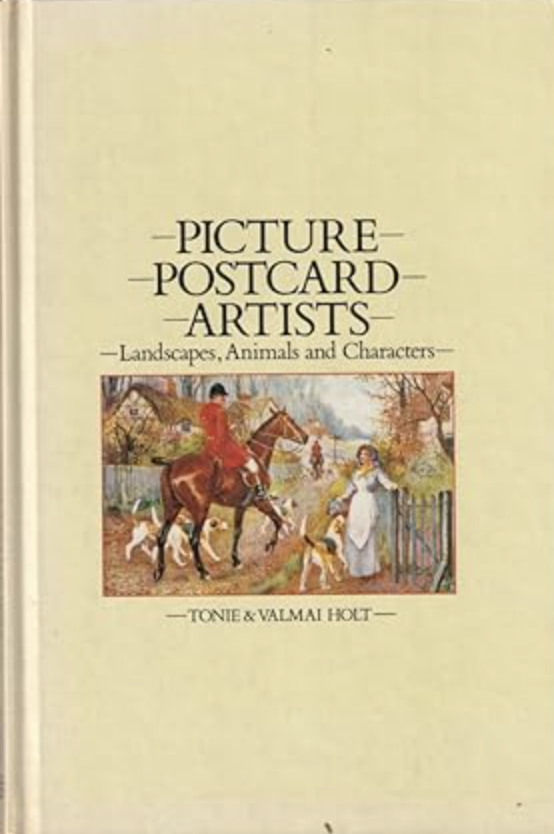 | Picture postcard artists – landscape, animals and characters (Longman, 1984, ISBN 9780582503182). Another handy book from Toni and Valmai Holt, this provides wealth of fascinating information on the artists who designed cards on some of the most popular collecting themes. It has three sections on ‘Landscapes and Views’, ‘Animals’ and ‘Character Studies, Literary and Ethnic Types’, and includes information on the main publishers, biographical details of the artists and colour and black & white images of many examples. |
 | Dictionary of Picture Postcards in Britain 1894-1939 by A.W. Coysh (Antique Collectors Club, 1984, ISBN 9781851492312). Again, although this came out in 1984, it is still a very helpful publication for anyone interested in postcards published in Britain in the late 19th and early 20th centuries. This large A4 format book with over 300 pages gathers together relevant facts about the artists, photographers, printers and publishers who were responsible for the vast output of picture postcards produced in the UK in this period. It is heavily illustrated with examples of any different kinds of postcards. |
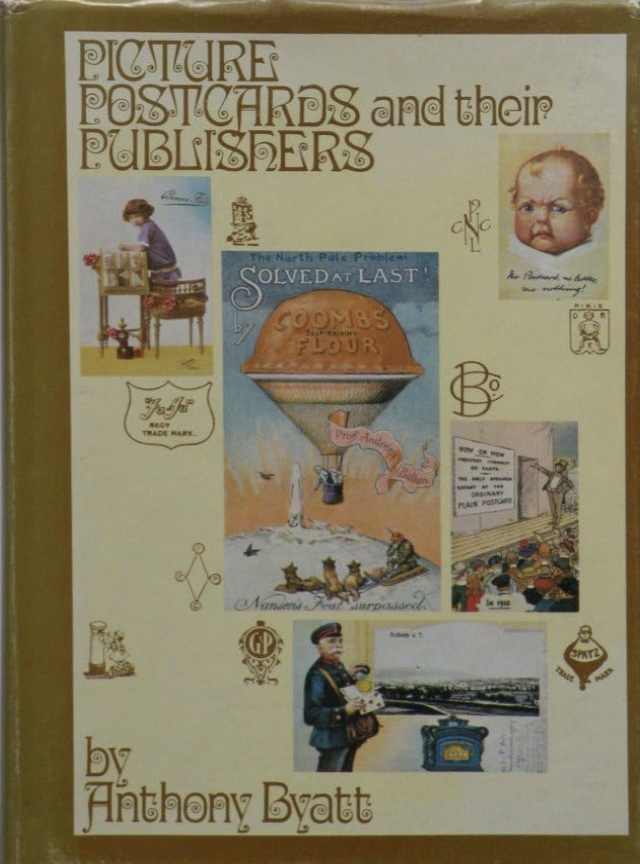 | Picture Postcards and their Publishers – an illustrated account identifying Britain’s major postcard publishers 1894-1939, and the great variety of cards they issued, by Anthony Byatt (Golden Age Books, 1978, ISBN 9780950621203). This work contains details of many of the main British postcard publishers, with black & white illustrations of a number of cards. There are useful illustrations of publisher’s Trade Marks ; an index of publisher’s initials, series names and trade mark names ; and an index of postcard artists. Although a relatively early publication in this field, it is packed with information that is still very useful. |
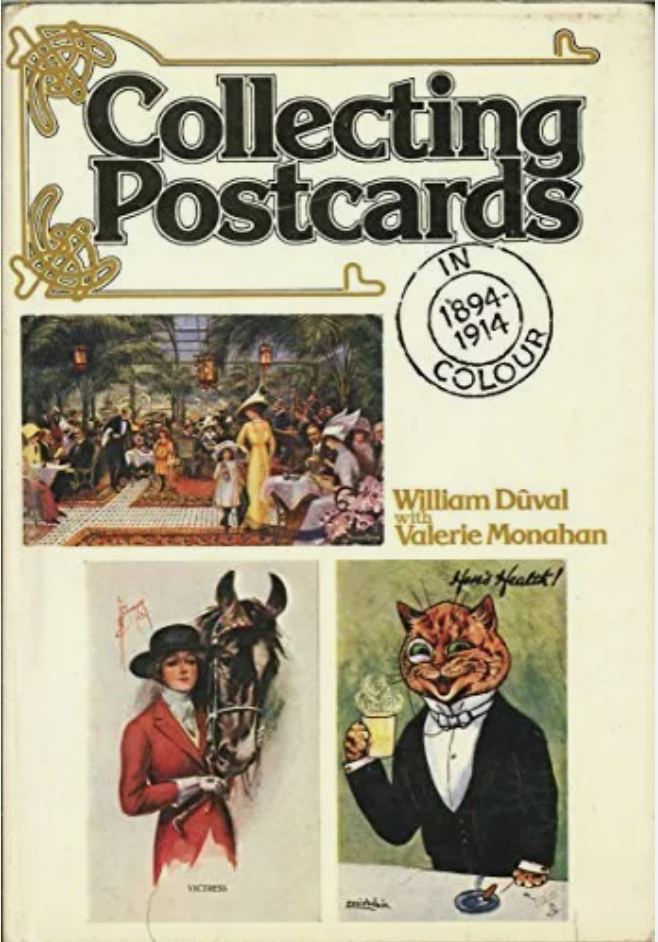 | Collecting postcards in colour, 1894-1914, by William David and Valerie Monahan, (Blandford Press, 1978, ISBN 9780713710809). This was the first of two volumes focusing on colour postcards, covering the period before the First World War (the second, which takes the story to 1930, is described below). It has several useful features. Firstly, there are 192 colour images across 66 pages, illustrating a wide range of postcard types, including topographicals, art, artist signed cards, seaside humour, transport, military and much more. As the publisher Blandford is well-known for their high-quality colour books, the reproduction quality is excellent. Secondly, there is a well-informed text section with advice on how to collect the various categories of cards. And finally, there is a reference guide to the relative rarity of different types of cards (as of 1978, at least !), categorised as plentiful ; specialised ; specialised in limited supply ; demand well exceeding supply ; and “almost impossible to find and very expensive when they are”. While this may not now be 100% accurate, it is still probably a pretty fair guide. |
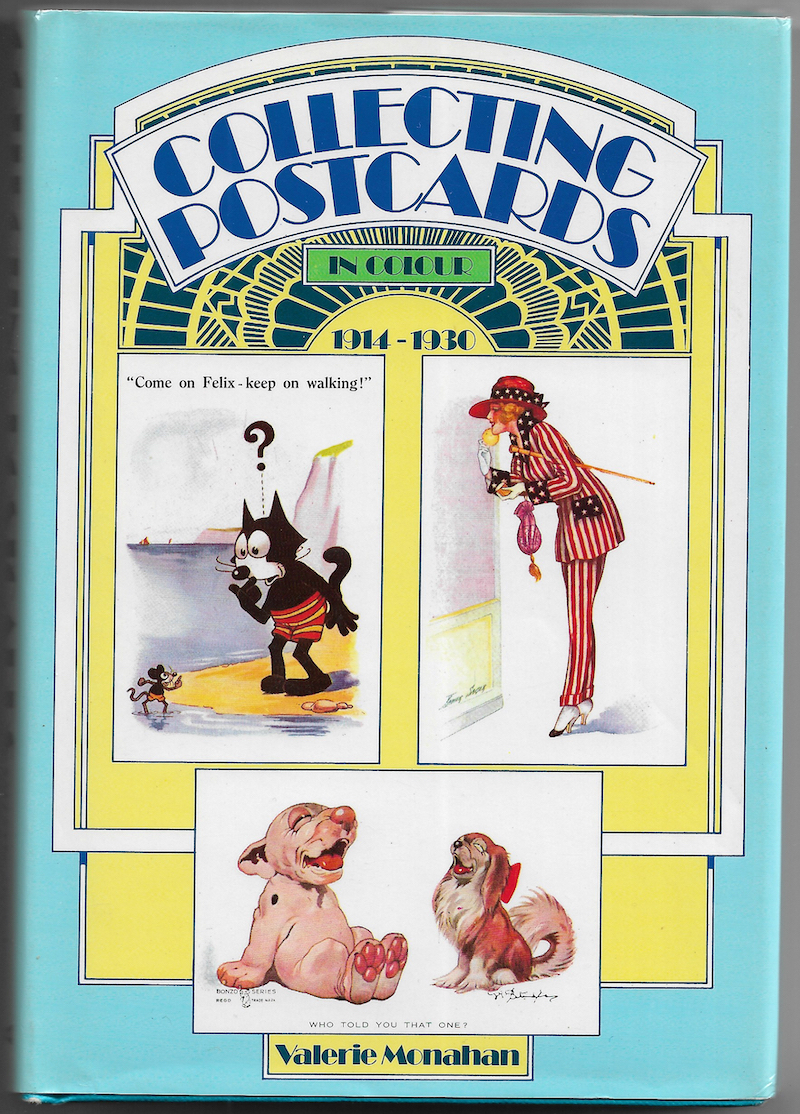 | Collecting postcards in colour, 1914-1930, by Valerie Monahan, (Blandford Press, 1980, ISBN 9780713710021). This was the second of two volumes focusing on colour postcards, covering the period from the First World War into the 1920s (the first volume, covering the period 1894-1914, is described above). It is organised in a slightly different way to the earlier volume. The colour section remains, with another 192 (mostly) colour images across 66 pages, and as the publisher is still Blandford, the reproduction quality remains excellent. The text is divided into sections on WW1 cards ; cards showing the social history of the 1920s ; a listing of some “best sellers” of the 1920s ; and details of some of the leading artists of the era. The reference guide to rarity and price is more limited, only being applied to those cards shown on the plates. |
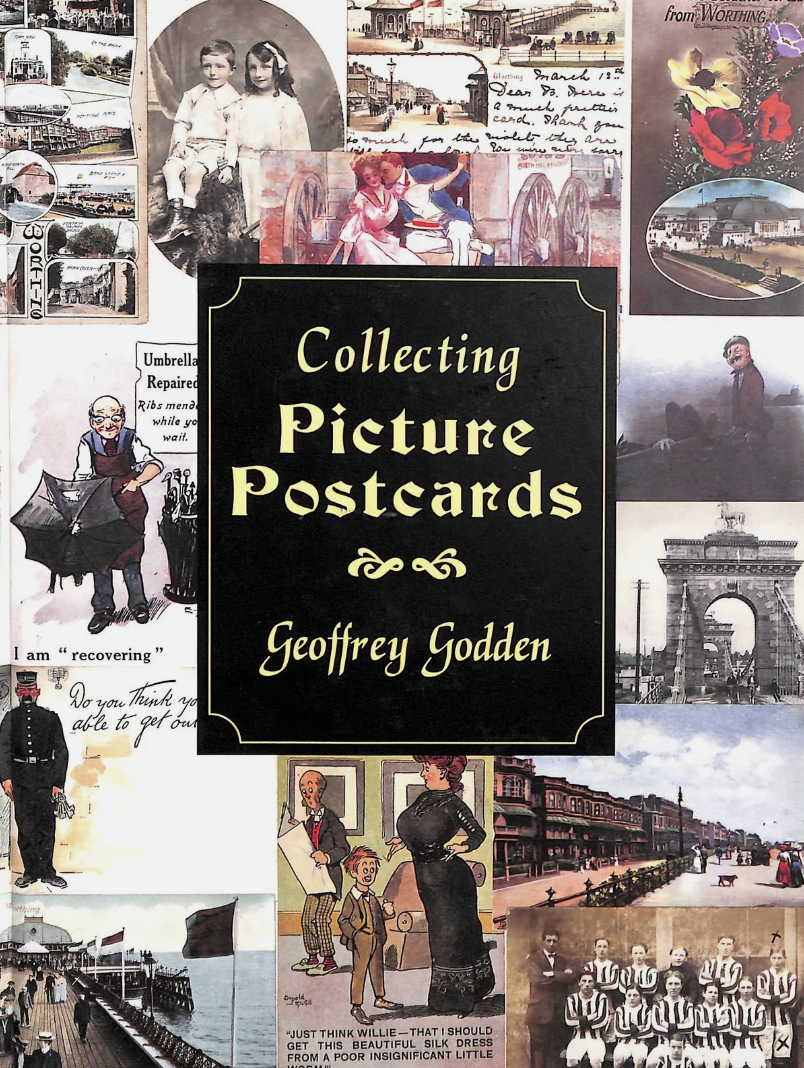 | Collecting picture postcards, by Godfrey Godden (Phillimore, 1996, ISBN 9780850339284). This appears, at first glance, to be simply a book about postcards of Worthing in Sussex, and you might be forgiven for passing it by. But it is in fact rather more than that. The author uses his home town as a typical British place for an examination of the history, development and attraction of picture postcards. As a popular seaside resort, Worthing is an excellent example of the mass-market postcard trade. Cards aimed at day-trippers and holiday-makers were sold in their thousands from souvenir shops, kiosks and cafes throughout the town, illustrating the beach, bandstand, promenade, pier, and much else besides. The same can be said, of course, of every British seaside town, from Ayr to Aberytswyth, Portobello to Portrush, and Rothesay to Ramsgate. Aspects of this trade explored by Dr Godden include popular local view cards ; home town cards by the French publisher Lévy ; event cards ; humorous cards ; and how to do local history research on your postcards. The book is an A4 hardback, with around 200 well-illustrated pages. |
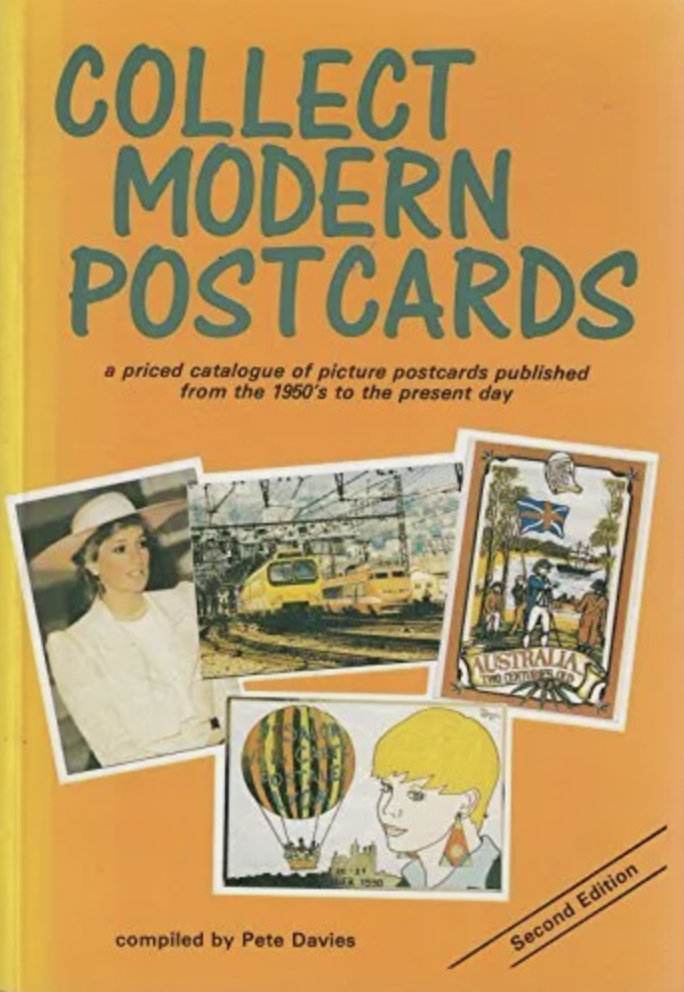 | Collect modern postcards – a price catalogue of picture postcards published from the 1960s to the present day, by Pete Davis (Reflections of a Bygone Age, 1990, Second Edition, ISBN 9780946245291). Not every collector focusses on the so-called “golden age” of postcards in the late 19th and early 20th century. Some pursue what are known as “moderns”, defined in this book as those published in the 1950s-1980s (we might not call that “modern” 40 years on, but the principle still applies). The attractiveness of these postcards, as much now as when it was published, is threefold : * they are usually much easier to find, both in the collecting market and indeed from tourist shops, museums, charity shops, and the like * they are usually cheaper than older cards (sometimes even free !) ; and * the production quality and condition is usually substantially better. Although many more cards are been made published since the book came out, it serves as a good basis for understanding what you might find. There is also perhaps now the added attraction, at least for topographical cards, of even more opportunities for “then and now” comparisons with city scenes or landscapes that may have changed dramatically in the last few decades (which might be a collecting focus in itself – I certainly use the principle in my own collection of Chinese cards). The book has a pricing guide, which although out of date in terms of cash values, may still be of use as an indication of relative prices. The volume also includes lists of publishers, photographers and artists for UK “moderns”, and checklists for some of the better known series. So why not give “moderns” another look ? And remember that a card published in 2024 will, some day, not be a “modern”. |
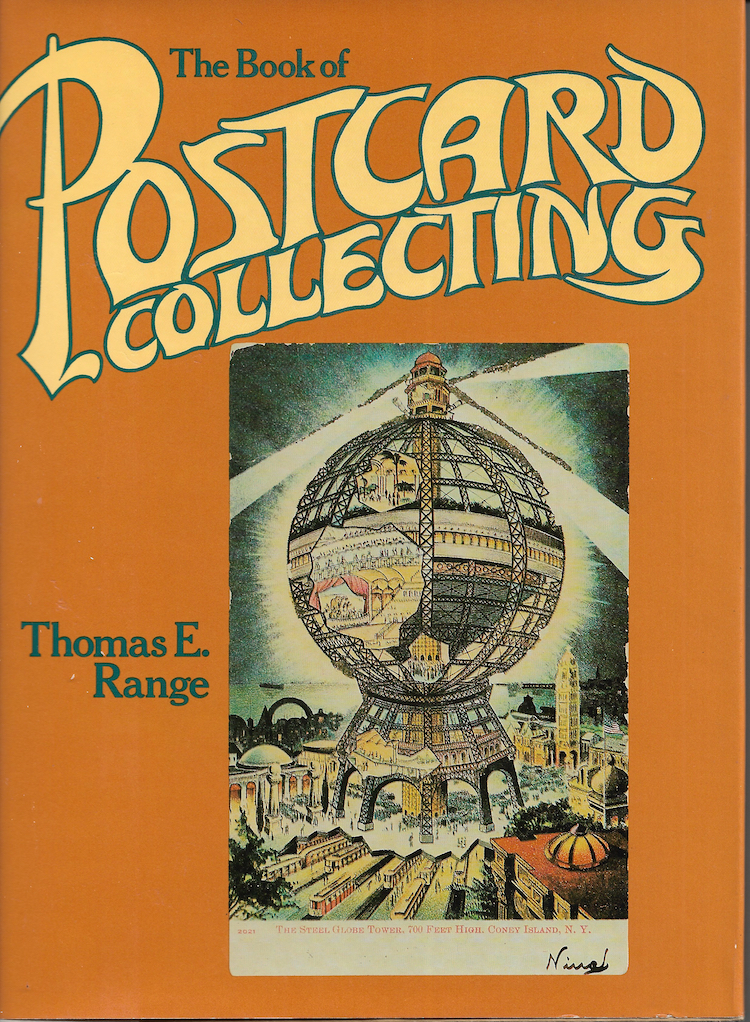 | The Book of Postcard Collecting, by Thomas E. Range (E.P. Dutton, 1980, ISBN 9780525931577). This is an American book, written by an experienced collector of New York cards. It does offer an interesting and perhaps less familiar perspective from “over the Pond”, which will be helpful to anyone collecting cards from the USA or on US topics. And as the author is also a stamp collector, his focus on the design of card backs, and some postal detail, is also helpful. The large format hardback (just under A4) is well illustrated with 32 colour images and 228 in black and white. It’s probably best to find a copy from a UK-based seller, to avoid extra postage costs. |
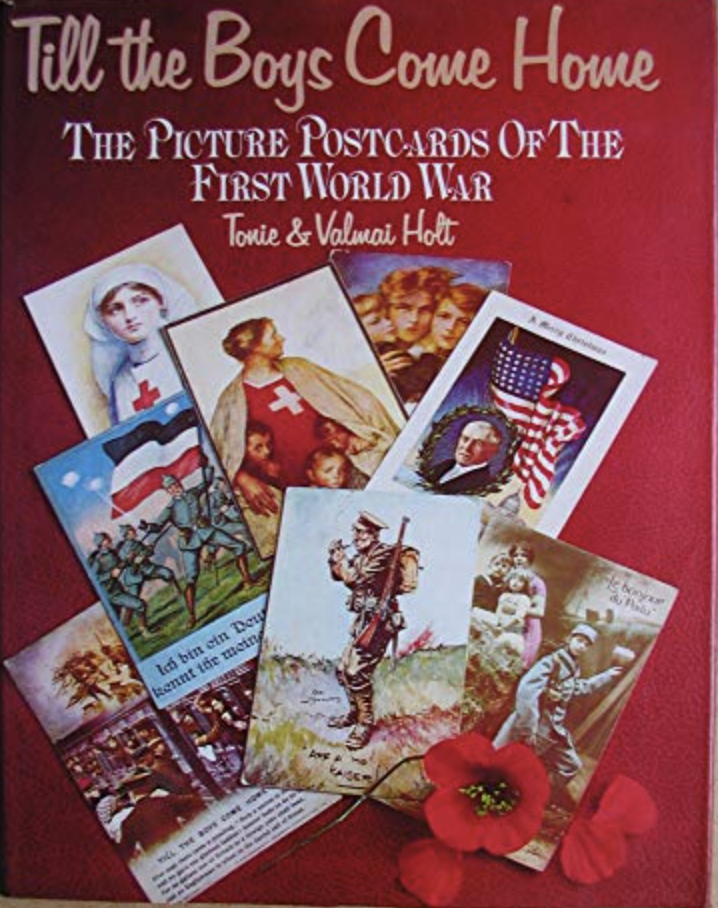 | Till the boys come home – the picture postcards of the First World War, by Tonie & Valmai Holt (McDonald & Janes, 1977, ISBN 9780354041669) World War 1 is a popular collecting theme, not just for the obvious military aspects, but also for cards illustrating social history, women at war, humour, propaganda, and much more. This large format hardback by the prolific team of Tonie and Valmai Holt is a great introduction to the topic, and is profusely illustrated with 729 colour and black & white images across 192 pages. Chapters include ‘The nations & the men who went to war’ ; ‘Propaganda – patriotism and hatred’ ; ‘The reality’ ; ‘Humour and sentiment’ ; ‘Back at home – women at war’ ‘ Pin-ups & Heroes’ ; cards from The Queen’s Collection ; and ‘Welcome Home !’ It also covers embroidered silks, a particular genre of postcards sent home by soldiers at the front, which remain very popular to collectors to this day (with prices to match). Copies of the original 1977 edition are still fairly easy to find at fair prices. There is also a later edition, produced in 2015 at the time of the 100th anniversary of the war, by Pen & Sword Books, ISBN 9781473823525. This has an additional 80 pages and 70 illustrations. |
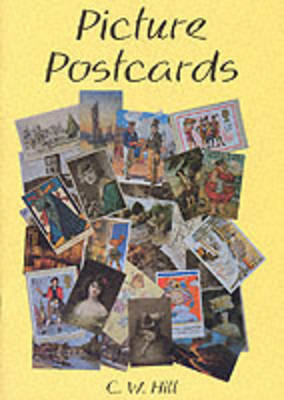 | Picture Postcards, by C W Hill (Shire Publications, 2007, ISBN 9780747803980). A small but perfectly formed beginners guide to Deltiology. |
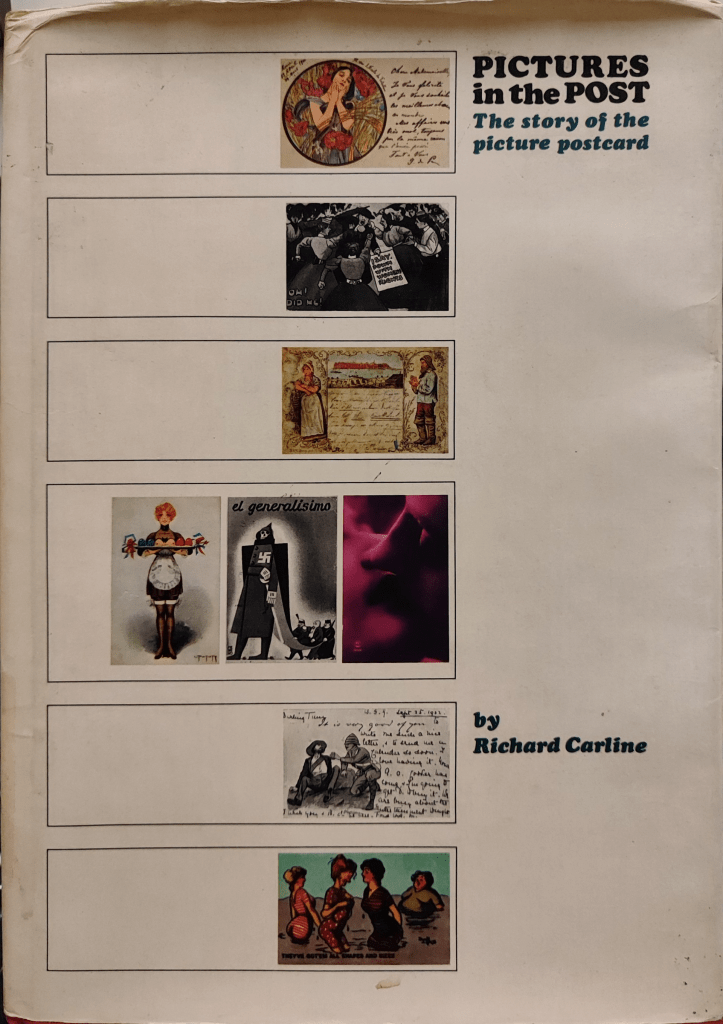 | PICTURES in the POST The story of the Picture Postcard, by Richard Carline (The Gordon Fraser Gallery Ltd, 1971, ISBN 0900406186). Richard Carline was one of a family of artists born and educated in Oxford. A pioneer in the study of picture postcards, he organised the first historical exhibition of the subject in 1945 entitled ‘Fifty Years of Picture Postcard Art’. |
Artists using postcards
| Description | Link |
| In 2025, a woman named Rosemary donated her lifelong postcard collection to an Edinburgh charity shop…we bought a fraction of them (a couple of small suitcases’ worth!) and began to respond to them through comics. | https://onionpress.cargo.site/rosemarys-collection |
| Jack Ravi is an artist living and working in Scotland, UK. He makes collage and assemblage art with found objects (vintage photos and studio postcards). | Shop — Jack Ravi | Found Objects Art & Classes |
| Amy Sterly is a printmaker and sculptor and originally from Chicago and uses stamps when creating mini artist books amongst other works. | Shop | Amysterly |
 Lothian Postcard Club
You must be logged in to post a comment.